B2 Bomber detailed explanation ( Ghost of the sky )
The Northrop Grumman B-2 Spirit , commonly known as the B-2 Stealth Bomber, is a U.S. Air Force heavy strategic bomber designed for stealth and long-range strike missions. Below is a detailed explanation of the B-2, including its features, parts, how they function, and the roles they play in its operation. The information is compiled from credible sources, with links provided for reference. I’ll break down the aircraft’s systems, components, and functionalities comprehensively, as requested.
Overview
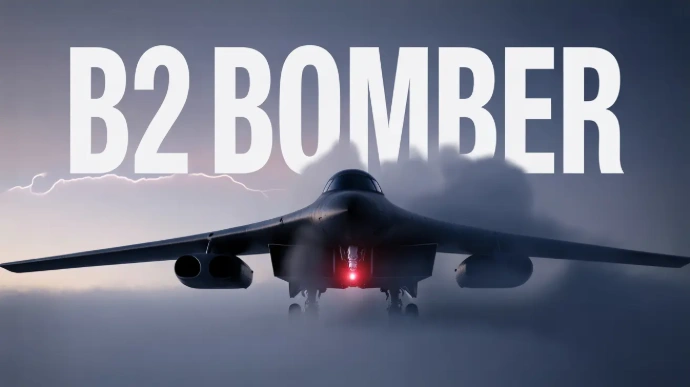
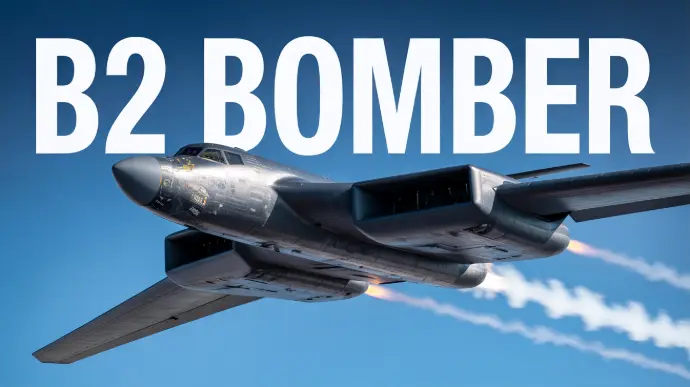
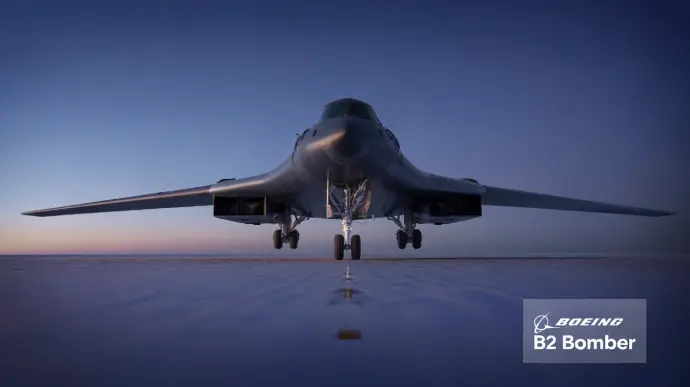
The B-2 Spirit is a low-observable, multi-role strategic bomber capable of delivering both conventional and nuclear munitions. Its primary role is to penetrate advanced enemy air defenses undetected, thanks to its stealth technology, and strike high-value targets with precision. The aircraft’s flying wing design, advanced materials, and sophisticated systems make it one of the most technologically advanced bombers in the world.
Key Features and Design
1. Flying Wing Configuration :
• Description: The B-2 has a tailless, bat-like design with no vertical stabilizers, resembling a boomerang. This reduces its radar cross-section (RCS), estimated to be ~0.001 m², comparable to a small bird.
• Function: The flying wing minimizes drag and radar reflection. Without a tail, the aircraft relies on computer-controlled fly-by-wire systems for stability, as the design is inherently aerodynamically unstable.
•Components:
a) Wing Structure: Constructed from composite materials (e.g., carbon-fiber-reinforced polymers) to reduce weight and radar signature.
b) Control Surfaces: Split rudders (or "drag rudders") on the wingtips act as air brakes and yaw control, replacing traditional rudders and ailerons.
2. Stealth Technology :
•Description: The B-2’s low observability is achieved through a combination of shape, materials, and design features to minimize radar, infrared, acoustic, and visual signatures.
•Function: Allows penetration of dense air-defense networks by evading radar, infrared sensors, and visual detection.
•Components:
a) Radar-Absorbent Materials (RAM): Special coatings and composites absorb radar waves. These require maintenance in climate-controlled hangars to preserve stealth properties.
b) Curved Surfaces: The smooth, blended shape scatters radar waves away from the source.
c) Exhaust Baffling: Engine exhausts are concealed and cooled to reduce infrared signatures, critical for evading heat-seeking missiles.
d)Low Acoustic Signature: Quiet operation minimizes detection by ground-based acoustic sensors.
3. Crew Compartment :
•Description: The B-2 is operated by a crew of two: a pilot (left seat) and a mission commander (right seat).
•Function: The crew manages flight operations, navigation, and weapons delivery, supported by automated systems for long missions (up to 44 hours with refueling).
Components
•Cockpit: Equipped with electronic flight instrumentation systems (EFIS) and heads-up displays (HUDs) showing flight, navigation, engine, and weapons data
•Crew Amenities: Includes a small toilet, a cot for resting, a microwave, and a mini-refrigerator to support extended missions.
•Ejection Seats: Two upward-ejecting seats for emergency escape, though used successfully in the 2008 Guam crash.
Major Systems and Parts
1. Power Plant :
a) Description: Four General Electric F118-GE-100 non-afterburning turbofan engines, each producing 17,300 pounds of thrust.
b) Function: Provides subsonic propulsion (max speed ~628 mph or 1,010 km/h) with high fuel efficiency for long-range missions.
Components:
a) Engines: Mounted in pairs on either side of the aircraft’s centerline, embedded within the wing to reduce radar and infrared signatures
b) Exhaust System: Uses baffles and cooling to minimize heat signatures, critical for stealth.
c)Fuel System: Large internal fuel tanks enable a range of 6,000 nautical miles (11,000 km) unrefueled, extendable to 10,000 nautical miles (19,000 km) with one midair refueling.
2. Avionics and Sensors:
a) Description: The B-2’s avionics suite includes navigation, communication, and targeting systems optimized for stealth and precision.
b) Function: Enables accurate navigation, target acquisition, and weapons delivery, even in GPS-denied environments.
Component
a) AN/APQ-181 Radar: A multi-mode, low-probability-of-intercept radar for terrain-following, navigation, and targeting. Its signals are designed to avoid detection.
b) Navigation Systems: Inertial navigation system (INS) combined with GPS for precision. The B-2’s radar often provides targeting accuracy surpassing intelligence data.
c) Electronic Countermeasures (ECM): Defensive systems to jam enemy radar and missiles, though specifics are classified.
d) Communication Systems: Secure, encrypted links for real-time coordination with command centers and other aircraft.
3. Weapons Systems:
a) Description: The B-2 can carry up to 40,000 pounds (18,144 kg) of ordnance in two internal bomb bays to maintain stealth.
b) Function: Delivers precision strikes with conventional or nuclear munitions against heavily defended targets.
Components
• Bomb Bays: Two bays equipped with rotary launchers or bomb racks, capable of carrying:
• Conventional Munitions: Up to 80 x 500-pound Mk 82 JDAM GPS-guided bombs, 36 x 750-pound CBU cluster bombs, or 16 x 2,000-pound Mk 84 bombs.
• Nuclear Munitions: Up to 16 x B61 or B83 nuclear bombs.
• Specialized Weapons: 2 x GBU-57 Massive Ordnance Penetrator (MOP), 30,000-pound bunker-busting bombs for deeply buried targets.
•Targeting System: Integrated with the AN/APQ-181 radar and GPS for precision delivery.
4. Flight Control System:
a) Description: A digital fly-by-wire system controls the aircraft’s complex aerodynamics.
b) Function: Compensates for the B-2’s inherent instability due to its tailless design, ensuring smooth and precise flight. Components
• Flight Control Computers: Process inputs from the crew and sensors to adjust control surfaces (elevons and split rudders).
• Elevons: Combined elevator-aileron surfaces on the trailing edge of the wing for pitch and roll control.
•Split Rudders: Act as yaw control and air brakes, located at the wingtips.
5. Landing Gear:
a) Description: Retractable tricycle landing gear supports the aircraft during takeoff, landing, and ground operations.
b) Function: Allows operation from standard runways while retracting to maintain stealth during flight.
Components
• Main Gear: Two four-wheel bogies retract into the wing structure.
• Nose Gear: A single two-wheel unit retracts into the forward fuselage.
Specifications
a) Dimensions:
• Wingspan: 172 feet (52.4 meters)
• Length: 69 feet (21 meters)
• Height: 17 feet (5 meters)
b) Weight: 160,000 pounds (72,575 kg) empty; max takeoff weight ~336,500 pounds (152,635 kg)
c) Speed: High subsonic (~628 mph or 1,010 km/h)
d) Combat Ceiling: 50,000 feet (15,000 meters)
e) Range: 6,000 nautical miles (11,000 km) unrefueled; 10,000 nautical miles (19,000 km) with one refueling
f) Crew: 2 (pilot and mission commander)
g) Unit Cost: ~$737 million (1997 dollars); ~$2.13 billion per aircraft including R&D (1997 dollars, ~$4.17 billion in 2024)
Operational History
1. Development: Initiated in the 1970s under the Advanced Technology Bomber (ATB) program to counter Soviet air defenses. Northrop Grumman won the contract in 1981, with the first flight on July 17, 1989.
2. Production: 21 aircraft built (originally planned for 132, reduced due to cost and Cold War’s end). Delivered between 1988 and 2000.
- Combat Operations:
a) Kosovo (1999): First combat use, dropping JDAMs during NATO’s Operation Allied Force.
b) Afghanistan (2001): Flew 44-hour missions from Missouri during Operation Enduring Freedom.
c) Iraq (2003):Supported Operation Iraqi Freedom with precision strikes.
d) Libya (2011, 2017): Struck targets in Operations Odyssey Dawn and Lightning.
e) Iran (June 2025): Seven B-2s conducted Operation Midnight Hammer, deploying 14 GBU-57 MOP bombs against nuclear sites, supported by 125 aircraft. Longest mission since 2001 (37 hours).
Accidents
• 2008: Crash in Guam due to sensor failure; both pilots ejected safely.
• 2022: Fire damaged one B-2, likely retired. 19 aircraft remain in service.
Maintenance and Challenges
• Stealth Maintenance: The B-2’s RAM coatings require climate-controlled hangars (B-2 Shelter Systems, ~$5 million each) and frequent reapplication, making maintenance costly (~$40 million annually per aircraft).
• Parts Scarcity: The small fleet size means limited spare parts, increasing costs. For example, surplus windshields were repurchased by the Air Force for maintenance.
Current Status and Future
1. Fleet: 19 B-2s operational, based at Whiteman Air Force Base, Missouri, with maintenance at Tinker Air Force Base, Oklahoma.
2. Role : Key component of the U.S. nuclear triad and global strike missions, with regular deterrence flights in Europe and Asia.
3. Replacement: The B-21 Raider will gradually replace the B-2 by 2040, with the B-2 expected to retire around 2032.
Credit to all sources
1. [U.S. Air Force: B-2 Spirit Fact Sheet](https://www.af.mil/About-Us/Fact-Sheets/Display/Article/104482/b-2-spirit/)
2. [Northrop Grumman: B-2 Stealth Bomber](https://www.northropgrumman.com/what-we-do/air/b-2-stealth-bomber/)
3. [Britannica: B-2 Stealth Bomber](https://www.britannica.com/topic/B-2)
4. [Wikipedia: Northrop B-2 Spirit](https://en.wikipedia.org/wiki/Northrop_B-2_Spirit)
5. [Hindustan Times: B-2 Stealth Bomber FAQs](https://www.hindustantimes.com/world-news/us-news/b-2-stealth-bomber)
6. [Air & Space Forces Magazine](https://www.airandspaceforces.com)
7. [Reuters: B-2 Bombers in Iran Strike](https://www.reuters.com)
8. X Posts: Used to confirm recent incidents (e.g., 2022 fire) but not primary evidence due to potential inaccuracies.
Note:
Classified Details: Some specifics (e.g., exact RCS, ECM capabilities, or advanced avionics) are classified, limiting public data.
B2 Bomber (Ghost of the sky )